
getOutput
Arguments
- ConcreteEst
"ConcreteEst" object
- Estimand
character: "RR" for Relative Risks, "RD" for Risk Differences, and "Risk" for absolute risks
- Intervention
numeric (default = seq_along(ConcreteEst)): the ConcreteEst list element corresponding to the target intervention. For comparison estimands such as RD and RR, Intervention should be a numeric vector with length 2, the first term designating "treatment" ConcreteEst list element and the second designating the "control".
- GComp
logical: return g-formula point estimates based on initial nuisance parameter estimation
- Simultaneous
logical: return simultaneous confidence intervals
- Signif
numeric (default = 0.05): alpha for 2-tailed hypothesis testing
- NIMargin
numeric (optional): a non-inferiority margin for the comparative (RD/RR) estimands. When supplied, a one-sided non-inferiority assessment is added (
NIpValue,NonInferior).- NIDirection
one of
"lower"or"upper": which side of the margin is "non-inferior". Use"upper"when a smaller estimate is better (the usual risk-difference case) and"lower"when larger is better.- x
a ConcreteOut object
- NullLine
logical: to plot a red line at y=1 for RR plots and at y=0 for RD plots
- ask
logical: to prompt for user input before each plot
- ...
additional arguments to be passed into plot methods
Value
data.table of point estimates and standard deviations. Comparative
estimands carry a two-sided Wald pValue. If the fit was built with
Strata (see formatArguments()), all standard errors are corrected for
the stratified / covariate-adaptive randomization design.
Examples
library(data.table)
library(concrete)
data <- as.data.table(survival::pbc)
data <- data[1:200, .SD, .SDcols = c("id", "time", "status", "trt", "age", "sex")]
data[, trt := sample(0:1, nrow(data), TRUE)]
#> id time status trt age sex
#> <int> <int> <int> <int> <num> <fctr>
#> 1: 1 400 2 1 58.76523 f
#> 2: 2 4500 0 1 56.44627 f
#> 3: 3 1012 2 1 70.07255 m
#> 4: 4 1925 2 1 54.74059 f
#> 5: 5 1504 1 0 38.10541 f
#> ---
#> 196: 196 2363 0 0 57.04038 f
#> 197: 197 2365 0 0 44.62697 f
#> 198: 198 2357 0 0 35.79740 f
#> 199: 199 1592 0 0 40.71732 f
#> 200: 200 2318 0 1 32.23272 f
# formatArguments() returns correctly formatted arguments for doConcrete()
concrete.args <- formatArguments(DataTable = data,
EventTime = "time",
EventType = "status",
Treatment = "trt",
ID = "id",
TargetTime = 2500,
TargetEvent = c(1, 2),
Intervention = makeITT(),
CVArg = list(V = 2))
# doConcrete() returns tmle (and g-formula plug-in) estimates of targeted risks
# \donttest{
concrete.est <- doConcrete(concrete.args)
#>
#> Estimating Treatment Propensity:
#>
#> Estimating Hazards:
#> Warning: Loglik converged before variable 1 ; coefficient may be infinite.
#> Warning: Loglik converged before variable 1,3 ; coefficient may be infinite.
#> Trt Time Event PnEIC RelativeCriteria AbsPnEIC
#> <char> <num> <num> <num> <num> <num>
#> 1: A=1 2500 1 0.0024001043 0.001867462 0.0024001043
#> 2: A=0 2500 2 -0.0063702933 0.009615051 0.0063702933
#> 3: A=1 2500 2 -0.0003148435 0.008512401 0.0003148435
#> AbsoluteCriteria StopCriteria RelativeRatio AbsoluteRatio ratio StopRule
#> <num> <num> <num> <num> <num> <char>
#> 1: 0 0.001867462 1.28522234 Inf 1.29 relative
#> 2: 0 0.009615051 0.66253349 Inf 0.66 relative
#> 3: 0 0.008512401 0.03698645 Inf 0.04 relative
#> StopAbsTol
#> <num>
#> 1: 0
#> 2: 0
#> 3: 0
#> Norm PnEIC = 0.006815149
#>
#> Starting TMLE Update:
#> Problem dimension: k = 4
#> Using standard universal LFM approach (iterative small steps)
#> Starting step 1 with update epsilon = 0.1
#> Update increased the active convergence objective, halving OneStepEps
#> Starting step 1 with update epsilon = 0.05
#> Update increased the active convergence objective, halving OneStepEps
#> Starting step 1 with update epsilon = 0.025
#> Trt Time Event PnEIC RelativeCriteria AbsPnEIC
#> <char> <num> <num> <num> <num> <num>
#> 1: A=1 2500 1 0.002273792 0.001867383 0.002273792
#> 2: A=0 2500 2 0.005521087 0.009612210 0.005521087
#> 3: A=0 2500 1 -0.001209543 0.005107295 0.001209543
#> AbsoluteCriteria StopCriteria RelativeRatio AbsoluteRatio ratio StopRule
#> <num> <num> <num> <num> <num> <char>
#> 1: 0 0.001867383 1.2176357 Inf 1.22 relative
#> 2: 0 0.009612210 0.5743827 Inf 0.57 relative
#> 3: 0 0.005107295 0.2368266 Inf 0.24 relative
#> StopAbsTol
#> <num>
#> 1: 0
#> 2: 0
#> 3: 0
#> Norm PnEIC = 0.00609487
#> Starting step 2 with update epsilon = 0.025
#> Update increased the active convergence objective, halving OneStepEps
#> Starting step 2 with update epsilon = 0.0125
#> Trt Time Event PnEIC RelativeCriteria AbsPnEIC
#> <char> <num> <num> <num> <num> <num>
#> 1: A=1 2500 1 0.0022111210 0.001867343 0.0022111210
#> 2: A=0 2500 1 -0.0002390974 0.005107428 0.0002390974
#> 3: A=0 2500 2 -0.0003917493 0.009613071 0.0003917493
#> AbsoluteCriteria StopCriteria RelativeRatio AbsoluteRatio ratio StopRule
#> <num> <num> <num> <num> <num> <char>
#> 1: 0 0.001867343 1.18410037 Inf 1.18 relative
#> 2: 0 0.005107428 0.04681366 Inf 0.05 relative
#> 3: 0 0.009613071 0.04075173 Inf 0.04 relative
#> StopAbsTol
#> <num>
#> 1: 0
#> 2: 0
#> 3: 0
#> Norm PnEIC = 0.002259054
#> Starting step 3 with update epsilon = 0.0125
#> Trt Time Event PnEIC RelativeCriteria AbsPnEIC
#> <char> <num> <num> <num> <num> <num>
#> 1: A=1 2500 1 0.0020409249 0.001867236 0.0020409249
#> 2: A=0 2500 2 0.0006443768 0.009612840 0.0006443768
#> 3: A=0 2500 1 -0.0001587924 0.005107558 0.0001587924
#> AbsoluteCriteria StopCriteria RelativeRatio AbsoluteRatio ratio StopRule
#> <num> <num> <num> <num> <num> <char>
#> 1: 0 0.001867236 1.09301931 Inf 1.09 relative
#> 2: 0 0.009612840 0.06703293 Inf 0.07 relative
#> 3: 0 0.005107558 0.03108968 Inf 0.03 relative
#> StopAbsTol
#> <num>
#> 1: 0
#> 2: 0
#> 3: 0
#> Norm PnEIC = 0.002146123
#> Starting step 4 with update epsilon = 0.0125
#> Update increased the active convergence objective, halving OneStepEps
#> Starting step 4 with update epsilon = 0.00625
#> Trt Time Event PnEIC RelativeCriteria AbsPnEIC
#> <char> <num> <num> <num> <num> <num>
#> 1: A=1 2500 1 1.955942e-03 0.001867184 1.955942e-03
#> 2: A=0 2500 2 -3.386572e-04 0.009613055 3.386572e-04
#> 3: A=1 2500 2 3.232335e-05 0.008512313 3.232335e-05
#> AbsoluteCriteria StopCriteria RelativeRatio AbsoluteRatio ratio StopRule
#> <num> <num> <num> <num> <num> <char>
#> 1: 0 0.001867184 1.047535643 Inf 1.05 relative
#> 2: 0 0.009613055 0.035228883 Inf 0.04 relative
#> 3: 0 0.008512313 0.003797247 Inf 0.00 relative
#> StopAbsTol
#> <num>
#> 1: 0
#> 2: 0
#> 3: 0
#> Norm PnEIC = 0.001985325
#> Starting step 5 with update epsilon = 0.00625
#> Trt Time Event PnEIC RelativeCriteria AbsPnEIC
#> <char> <num> <num> <num> <num> <num>
#> 1: A=1 2500 1 1.867586e-03 0.001867131 1.867586e-03
#> 2: A=0 2500 2 2.071158e-04 0.009612931 2.071158e-04
#> 3: A=0 2500 1 -5.176869e-05 0.005107594 5.176869e-05
#> AbsoluteCriteria StopCriteria RelativeRatio AbsoluteRatio ratio StopRule
#> <num> <num> <num> <num> <num> <char>
#> 1: 0 0.001867131 1.00024373 Inf 1.00 relative
#> 2: 0 0.009612931 0.02154554 Inf 0.02 relative
#> 3: 0 0.005107594 0.01013563 Inf 0.01 relative
#> StopAbsTol
#> <num>
#> 1: 0
#> 2: 0
#> 3: 0
#> Norm PnEIC = 0.001879926
#> Starting step 6 with update epsilon = 0.00625
#> Trt Time Event PnEIC RelativeCriteria AbsPnEIC
#> <char> <num> <num> <num> <num> <num>
#> 1: A=1 2500 1 1.777413e-03 0.001867078 1.777413e-03
#> 2: A=0 2500 2 -1.536649e-04 0.009613012 1.536649e-04
#> 3: A=1 2500 2 2.615163e-05 0.008512319 2.615163e-05
#> AbsoluteCriteria StopCriteria RelativeRatio AbsoluteRatio ratio StopRule
#> <num> <num> <num> <num> <num> <char>
#> 1: 0 0.001867078 0.951975869 Inf 0.95 relative
#> 2: 0 0.009613012 0.015985094 Inf 0.02 relative
#> 3: 0 0.008512319 0.003072211 Inf 0.00 relative
#> StopAbsTol
#> <num>
#> 1: 0
#> 2: 0
#> 3: 0
#> Norm PnEIC = 0.001784263
# getOutput returns risk difference, relative risk, and treatment-specific risks
# GComp=TRUE returns g-formula plug-in estimates
# Simultaneous=TRUE computes simultaneous CI for all output TMLE estimates
concrete.out <- getOutput(concrete.est, Estimand = c("RR", "RD", "Risk"),
GComp = TRUE, Simultaneous = TRUE)
print(concrete.out)
#> Time Event Estimand Intervention Estimator Pt Est se CI Low
#> <num> <num> <char> <char> <char> <num> <num> <num>
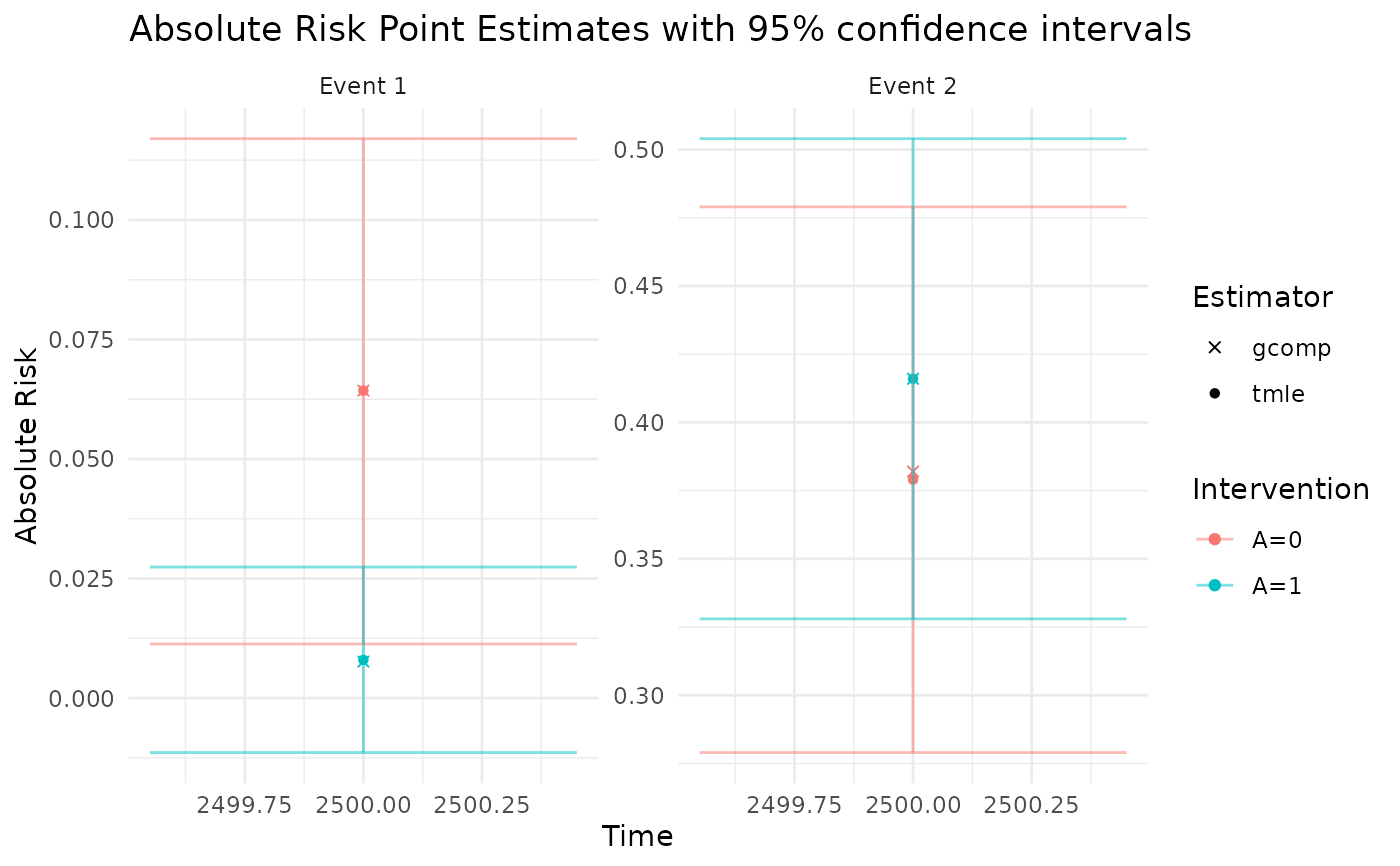
#> 1: 2500 1 Abs Risk A=0 tmle 0.06430 0.02710 0.0113
#> 2: 2500 1 Abs Risk A=0 gcomp 0.06430 NA NA
#> 3: 2500 1 Abs Risk A=1 tmle 0.00798 0.00989 -0.0114
#> 4: 2500 1 Abs Risk A=1 gcomp 0.00762 NA NA
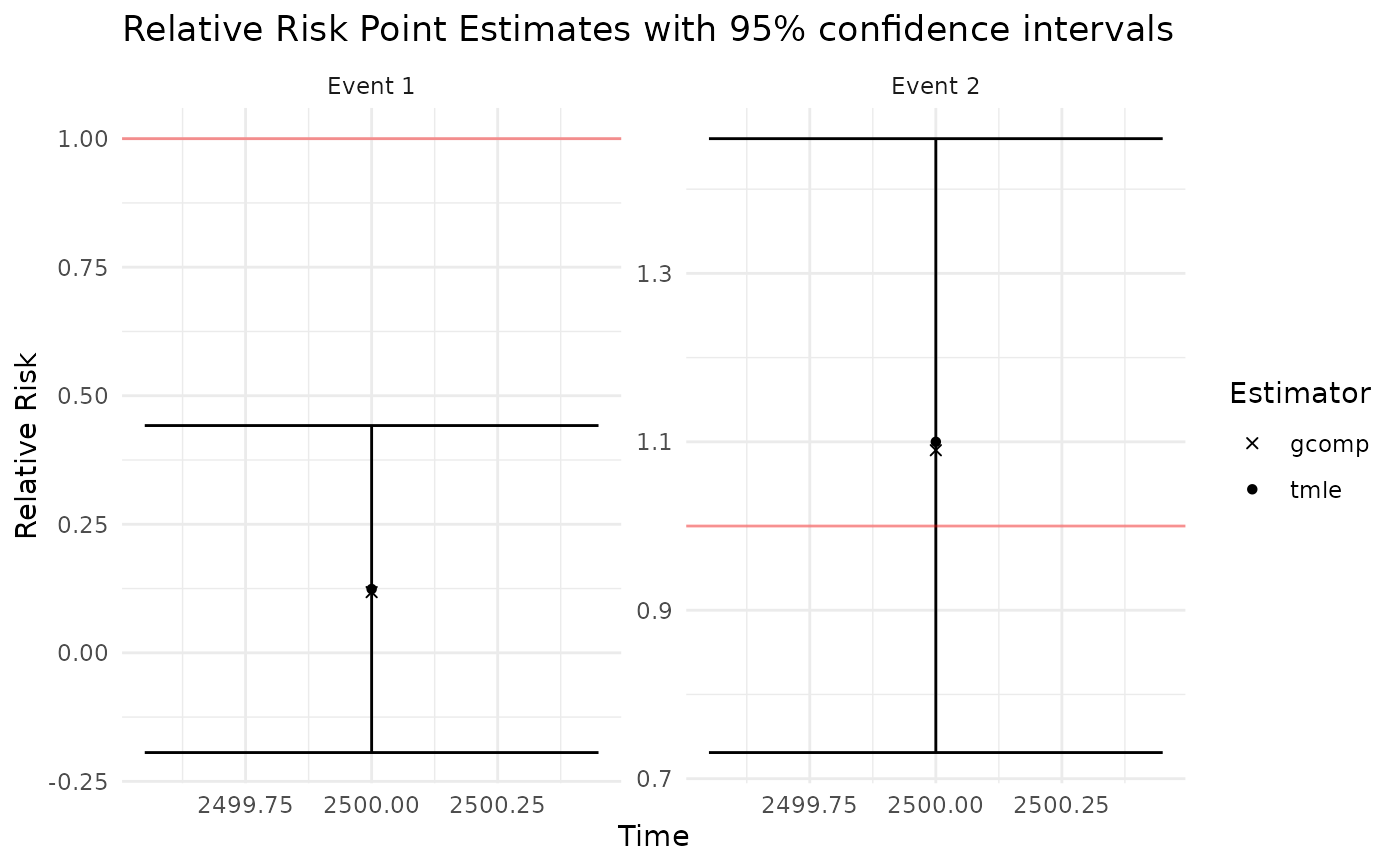
#> 5: 2500 1 Rel Risk [A=1] / [A=0] tmle 0.12400 0.16200 -0.1940
#> 6: 2500 1 Rel Risk [A=1] / [A=0] gcomp 0.11800 NA NA
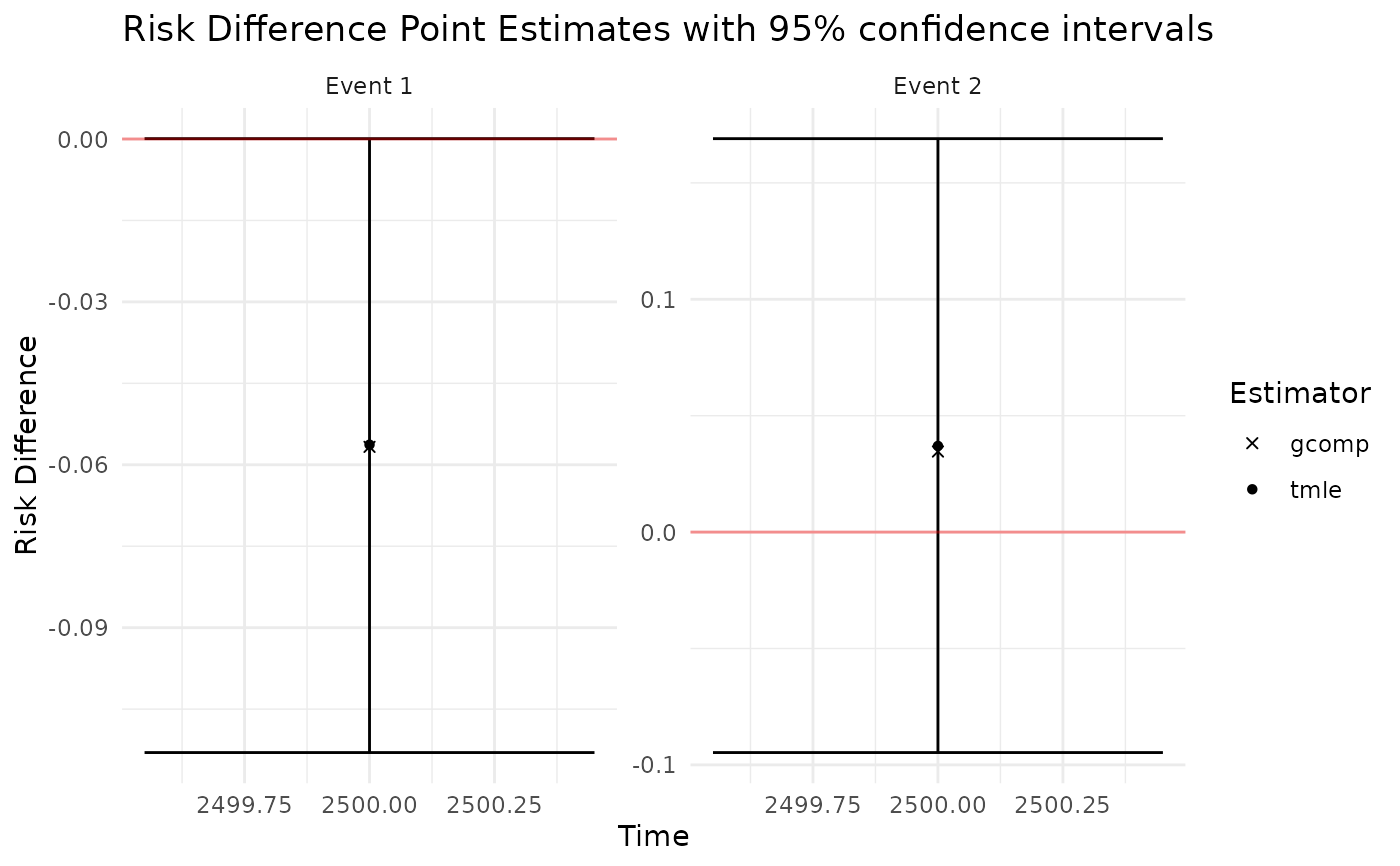
#> 7: 2500 1 Risk Diff [A=1] - [A=0] tmle -0.05630 0.02880 -0.1130
#> 8: 2500 1 Risk Diff [A=1] - [A=0] gcomp -0.05670 NA NA
#> 9: 2500 2 Abs Risk A=0 tmle 0.37900 0.05090 0.2790
#> 10: 2500 2 Abs Risk A=0 gcomp 0.38200 NA NA
#> 11: 2500 2 Abs Risk A=1 tmle 0.41600 0.04510 0.3280
#> 12: 2500 2 Abs Risk A=1 gcomp 0.41600 NA NA
#> 13: 2500 2 Rel Risk [A=1] / [A=0] tmle 1.10000 0.18700 0.7310
#> 14: 2500 2 Rel Risk [A=1] / [A=0] gcomp 1.09000 NA NA
#> 15: 2500 2 Risk Diff [A=1] - [A=0] tmle 0.03700 0.06720 -0.0947
#> 16: 2500 2 Risk Diff [A=1] - [A=0] gcomp 0.03460 NA NA
#> CI Hi SimCI Low SimCI Hi pValue
#> <num> <num> <num> <num>
#> 1: 1.17e-01 -0.00459 0.1330 NA
#> 2: NA NA NA NA
#> 3: 2.74e-02 -0.01720 0.0332 NA
#> 4: NA NA NA NA
#> 5: 4.42e-01 -0.28900 0.5370 6.7e-08
#> 6: NA NA NA NA
#> 7: 6.33e-05 -0.13000 0.0169 5.0e-02
#> 8: NA NA NA NA
#> 9: 4.79e-01 0.24900 0.5090 NA
#> 10: NA NA NA NA
#> 11: 5.04e-01 0.30100 0.5310 NA
#> 12: NA NA NA NA
#> 13: 1.46e+00 0.62100 1.5700 6.0e-01
#> 14: NA NA NA NA
#> 15: 1.69e-01 -0.13400 0.2080 5.8e-01
#> 16: NA NA NA NA
plot(concrete.out, ask = FALSE)
 # }
# }